Monday, December 9, 2013

Unit 3 reflection
In Unit 3, I have learned about action and reaction pairs, Newton's 3rd law, how tug of war works, how a horse is able to pull a buggy, adding forces, vectors at angles, gravity and tides, momentum, impulse and momentum relationship, and the conservation of momentum.
Action and reaction pairs/ Newton's 3rd law
Newtons third law states: every action has an equal and opposite reaction. That means if you touch someone then they touch you back with the same amount of force. In order to find that force you would use the equation:
F=Ma
Reaction and action pairs, are examples of Newton's 3rd law. Here are some examples:

How do you win a tug of war contest? It all depends on your firm stance on the ground, because you push ground forward therefore the ground pushes you backward. If you were to wear socks while playing tug of war you would most likely be part of the losing team. This is because if you do not have good traction with the ground you will just slide forward.
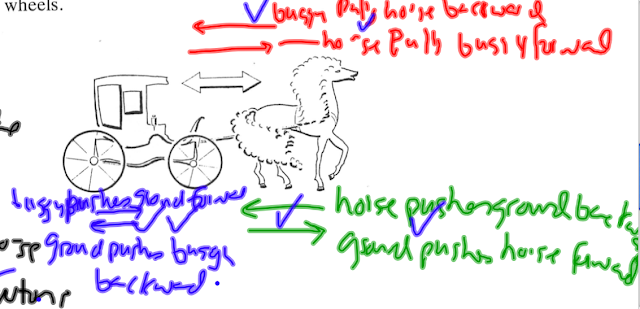
How does a horse pull a buggy forward? First it is important to look at the action and reaction pairs, in order to see how the horse is able to pull the buggy forward.


-J=p


Action and reaction pairs/ Newton's 3rd law
Newtons third law states: every action has an equal and opposite reaction. That means if you touch someone then they touch you back with the same amount of force. In order to find that force you would use the equation:
F=Ma
Reaction and action pairs, are examples of Newton's 3rd law. Here are some examples:
In this picture the man is pushing the wall with 100N so, because of Newton's third law, the wall will push the man back with the same amount of force that the man pushes on the wall.
Another example would be: rocket pushes fuel backward so fuel pushes rocket forward or hammer pushes nail so nail pushes hammer
No matter how hard you push on something it will push back on you with the exact same force. Forces do not exist without other forces.
Tug of war and horse and buggy
How do you win a tug of war contest? It all depends on your firm stance on the ground, because you push ground forward therefore the ground pushes you backward. If you were to wear socks while playing tug of war you would most likely be part of the losing team. This is because if you do not have good traction with the ground you will just slide forward.
How does a horse pull a buggy forward? First it is important to look at the action and reaction pairs, in order to see how the horse is able to pull the buggy forward.

It is important to remember Newton's third law (every action has an equal and opposite reaction). This would mean that the horse and buggy pull on each other with the same amount of force.
So why does the horse pull the buggy forward? Because the horse pushes on the ground with more force than the buggy pushes on the ground. When looking at the diagram it is important to notice that the arrows that say horse pushes ground back ward therefor the ground pushes the horse forward are longer than the arrows that say the buggy pushes ground forward therefore the ground pushes the buggy backward.
Adding forces and Vectors with angles
Vectors are used in order to find things such as the tensions in a rope like the following:

The more tension something (rope) has....the more likely it is to break.

In this diagram the right side would be more likely to break, because there is more tension.
Why does a box slide down a ramp?

Because the gravity pushes it down and the ramp pushes it up, so when the vectors are added together it shows that the box will slide down the ramp.
Gravity and tides
The universal gravitational force says that, everything with mass attracts al other things with mass. And the formula for this is F=G(m1m2/d^2).
What does force depend on?
1.) the mass of objects because force is proportional to mass. The small the objects the smaller the force.
2.) the distance between the objects. The force is proportional to 1/d. The greater the distance the weaker the force and the smaller the distance means that the force is more powerful.
Is the force of gravity greater at high elevations or at sea level?
It is greater at sea level, because the distance would be much smaller at the beach then say at Mt. Everest. This is because it is measured from the center of the earth which is closer to sea level than Mt. Everest is. 

Why are there high tides on both sides of the earth? Why not just the side closest to the moon, because the force is greater with the smaller amount of distance?
Because when the earth pulls on the moon, the moon pulls back on the earth so that is why there is a high tide on the opposite side of the earth.
When the sun, moon, and the earth are all in line we experience Spring tides. (full/ new moon) This means that the tides are higher than they normally are.
When we experience a half moon then the tides are called neap tides. This means that the tides are lower than they normally are.
Although the sun has a stronger force on the earth than the moon (because it has a greater mass), the difference between the moon and the earth and the sun and the earth is smaller, so it has a stronger force on the earth thus the distance is what causes tides.

Momentum/ Impulse and momentum relationship
The proper way to answer a question regarding Momentum and Impulse, is:
Why do climbers prefer stretchy ropes to non-stretchy ropes?
-Because no matter how the climber is stopped, the climber goes from moving to not moving, therefore the change in momentum is the same no matter how the climber is stopped.
-p=mv
-p= pfinal-pinitial
- Since the change in momentum is the same no matter how the climber is stopped, the impulse will also be the same

---------------> the more time= the less force
-The climber prefers a stretchy rope rather than a non-stretchy rope, because it increases the time it takes for the climber to come to a stop, thus because the impulse is constant the force will be less. A smaller force means the less injury when the climber comes to a stop.
Conservation of momentum
The conservation of momentum means that the momentum before, after, and during the collision is the same no matter what. This means that if a car and a truck collide head on the momentum of the system will always be the same. The momentum of the singular car though can have a change in momentum, just not the whole collision.
Here is an example:
Cart A and Cart B are moving in opposite directions and they stick together after they collide.
How fast will the carts be moving after the collision and in which direction will the carts be traveling?

Conclusion
The most difficult part of this unit for me was understanding vectors as well as the momentum and impulse relationship. I feel like this blog post has helped me to review those concepts so reviewing my notes and having to explain these things really helped me. Another thing that has helped me is watching the podcasts made by my classmates, as well as making one with my group.
I would say that I have put a lot of effort into the class and I really enjoy to structure of the class. I have completed almost every homework assignment and have come in during conference period if I didn't understand something. I also feel that working in small groups has helped me grow in this class. It is nice to be able to discuss certain concepts that I struggle with and ask questions.
Thursday, November 14, 2013
Tides resource
This video provides a very clear and engaging explanation of tides and how the moon and the sun have to do with it. The creator of this video made a diagram of where the moon has to be when there is a high tide and low tide. The side closest to the moon will experience high tide because of the gravitational pull and the opposite side will experience the high tide as well because the earth is pulling on the moon as well as the moon is pulling on the earth. I definitely believe that this video helped me to see how the tides are effected by the moon. When the moon is full then the tides will be higher than normal and when it is a half moon the tides are lower than normal.
Friday, November 1, 2013
Unit 2 Reflection
Newton's Second Law:
Newton's Second law states that acceleration is directly proportional to force and inversely proportional to mass, or a=F/m. Whenever mass increases, the acceleration. When looking at mass vs. weight, weight=(mass)(gravity), or w=mg. and example equation of this is:

Newton's Second law states that acceleration is directly proportional to force and inversely proportional to mass, or a=F/m. Whenever mass increases, the acceleration. When looking at mass vs. weight, weight=(mass)(gravity), or w=mg. and example equation of this is:

Skydiving:
Skydiving is an example of Newton's second law in action. Here is a diagram of what happens when you leave the plane:

In the last part of the picture, the skydiver is in terminal velocity which means they are going as fast as they possibly can but are no longer accelerating. After they reach terminal velocity they parachute goes up. Once the parachute comes out, the surface area increases as well as the net force. The velocity continues in the downward direction, but now the acceleration is in the upward direction. This means that the skydiver is slowing down. Then the skydiver hits terminal velocity again where the F air is the same as before but the skydiver is moving slower, because of the parachute. They are no longer accelerating, but are moving in the downward direction.
Free Fall:
Free fall is when an object falls, with no air resistance. An example of this that was shown in class is a penny and a feather were placed in a tube with no air in it. When the tube was flipped over, the penny and the feather hit the ground at the same time. The only force acting on a object in free fall is the force of gravity. The equation used to determine the acceleration in free fall is : a=fnet/m. When you are searching for the distance, you use the equation: d=1/2dg^2. And when you want to know the velocity the equation v=gt is used.
Projectile Motion (falling at an angle):
Projectile motion is when something is thrown or dropped. An example is when you drop two balls on the ground. If you were to shoot a ball off a table and drop a ball of the same table at the same time, they would hit the ground at the same time. The only thing that matters is the height. The balls hit the ground at the same time, because they left from the same height. When a person jumps off a cliff you must know the vertical and horizontal distances, speed, and time. When determining horizontal you use the equation: v=d/t. When determining the vertical you use: v=gt or d=1/2gt^2. When you hit the ground, you realize that you took a curved path, because you are moving both vertically and horizontally.
Free Fall (falling straight down):
Free fall is when something falls and the only force acting on it is the force of gravity. The main thing to know about free fall is that there is NO air resistance. The weight of the object falling in free fall does not matter, because the only force acting is the force of gravity. If you were trying to figure out how high a cliff is and the only information is that an object falls off of it and falls for 9 seconds. You would use the equation d=1/2gt^2.
Free fall (throwing things straight up):
When you throw an object straight up, neglecting air resistance, the object stops at the top of it's path and falls back down. The balls acceleration remains constant the whole time. The acceleration is 10 m/s^2, even when the ball's velocity is 0 m/s at the top of it's path. If the ball starts off at 40 m/s then the next second will be 30 m/s and the velocity will continue to go down until it is at the top of it's path and then it will accelerate back down at 10 m/s^2.
Monday, October 21, 2013
Free Fall Resource
In this video, a man explains exactly what free fall is. He preforms a demonstration with a heavy ball and a light ball. He drops the two balls and they hit the table at the same time. He then goes on to explain why this happens. The reason the balls hit the table at the same time is because they have the same acceleration.
Sunday, October 13, 2013
Newton's 2nd Law Resource
This video was really helpful in understanding exactly what Newton means in his 2nd law. The demonstration of the balls being shot out of 2 tubes helped me see that an object with less mass will move quicker than an object with more mass. This video helped me see Newton's 2nd law in a real life scenario.
Monday, September 30, 2013
Subscribe to:
Posts (Atom)